What to Know About a Back Injury Car Crash
A back injury car crash is one of the most common — and most underestimated — outcomes of a motor vehicle collision.
Here is a quick overview of what you need to know:
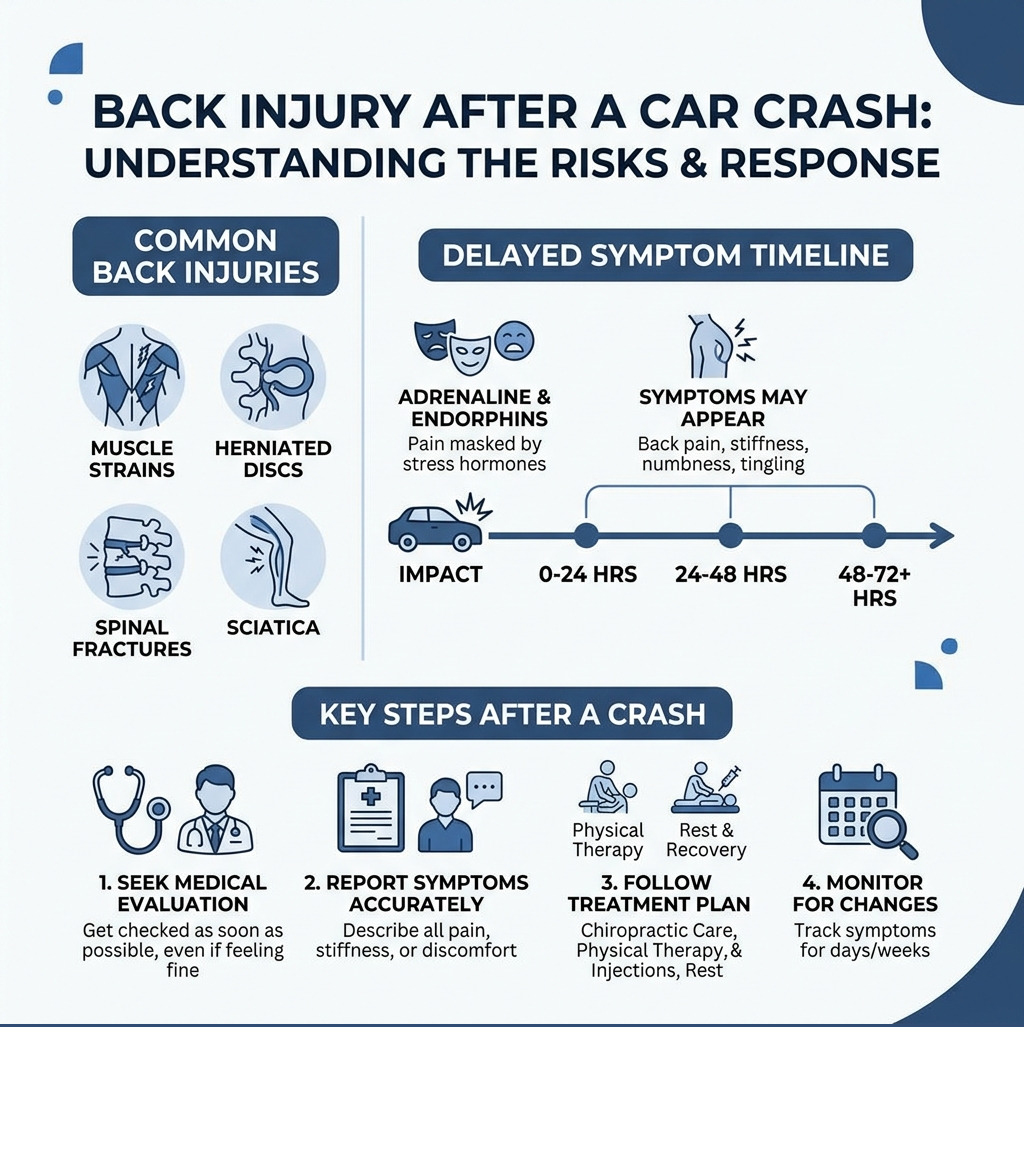
- Most common injuries: muscle strains, herniated discs, spinal fractures, sciatica, facet joint damage
- Key symptoms: back pain, stiffness, numbness, tingling, radiating leg pain, muscle spasms
- Why pain is often delayed: adrenaline and endorphins mask symptoms for 24–72 hours after impact
- What to do first: seek medical evaluation as soon as possible, even if you feel fine
- Treatments available: chiropractic care, physical therapy, injections, and in severe cases, surgery
- Why it matters: untreated back injuries can become chronic, lasting months or years
Back and spine injuries are among the most frequently reported consequences of car accidents. According to the National Highway Traffic Safety Administration, nearly 1.9 million people were injured in passenger vehicle crashes in 2022 alone. Research shows that the lumbosacral region — your lower back — is the most commonly injured part of the spine in car accidents, accounting for nearly 65% of crash-related spinal fractures.
Even a crash that feels minor in the moment can transfer enormous force through your spine. Tampa’s busy corridors — from I-275 to the Howard Frankland Bridge — see their share of rear-end collisions and high-speed impacts every day. Whether you walked away from the scene or were taken by ambulance, what happens after the crash matters just as much as the crash itself.
Ignoring back pain after a wreck is a risk you simply cannot afford to take.
I’m Vasilios Nenos, founder of MAST Health and a licensed chiropractic physician with advanced training in clinical neurology, and I’ve worked with many Tampa patients navigating the physical and functional challenges that follow a back injury car crash. In the sections below, I’ll walk you through everything you need to understand — from anatomy and diagnosis to treatment and recovery.
Understanding Your Back Injury After a Car Crash

When you are driving down Dale Mabry Highway or navigating the heavy merge onto I-275, your body is in a state of relative rest. When another vehicle strikes yours, that rest is shattered by Newton’s laws of motion. Your car stops or changes direction instantly, but your body continues to move until restrained by a seatbelt or an airbag.
The spine is a marvel of engineering, but it isn’t designed to absorb the jarring, multi-directional forces of a high-velocity collision. Even with modern safety features, the “whiplash” effect isn’t limited to the neck; it often extends deep into the thoracic (middle) and lumbar (lower) spine. While seatbelts save lives by anchoring the pelvis, they can also create a pivot point. In a back injury car crash, the lower torso stays put while the upper body is flung forward or sideways, leading to severe compression and stretching of spinal tissues.
At MAST Health, we look at the whole-body impact of these forces. Our Our Services are designed to address the root cause of the pain rather than just masking the symptoms with a temporary fix.
Anatomy of the Spine
To understand why your back hurts, we have to look at the “hardware.” Your spine consists of 33 vertebrae. In a car accident, these bony structures can fracture or shift. Between each vertebra sits an intervertebral disc—a gel-filled cushion that acts as a shock absorber. A crash can cause these discs to bulge or rupture.
Running through the center of these bones is the spinal cord, the superhighway for nerve signals. Branching off are nerve roots that travel to your arms and legs. When a back injury car crash occurs, any displacement of bone or disc material can pinch these nerves, leading to the “electric shock” sensations many Tampa residents report after a wreck.
How Accident Type Influences Injury
The “how” of your accident dictates the “what” of your injury.
- Rear-End Collisions: These are the most common causes of whiplash and lumbar strains. The sudden acceleration-deceleration force often causes the spine to “S-curve,” putting immense pressure on the facet joints.
- T-Bone Accidents: Side impacts are particularly dangerous because the spine has less lateral flexibility. These often result in thoracic spine injuries or disc herniations.
- Rollover Risks: Rollovers are catastrophic. Research indicates a ninefold increase in the risk of multiple associated injuries during a rollover, often involving complex spinal fractures.
Whether you were hit on the Selmon Expressway or a quiet street in Carrollwood, the physics remain the same: your spine absorbed energy it wasn’t meant to handle.
Common Spinal Injuries and Delayed Symptoms
Not all injuries are immediately visible. While a broken bone is obvious, soft tissue damage—the stretching and tearing of muscles and ligaments—can be just as debilitating. This is why Auto Accident Injury Rehabilitation is such a critical part of the recovery process in Tampa.
Common symptoms of a back injury car crash include:
- Muscle spasms that feel like a “knot” in the back
- Stiffness that makes it hard to get out of bed in the morning
- Sharp, stabbing pain when twisting or bending
- A dull, persistent ache that worsens with sitting
- Numbness or “pins and needles” in the extremities
Herniated Discs and Sciatica
One of the most frequent diagnoses we see after a Tampa wreck is a herniated disc. Think of a disc like a jelly donut; the crash pressure causes the “jelly” (nucleus pulposus) to leak out through a tear in the outer ring. This material often presses against the sciatic nerve.
If you are feeling pain that shoots from your lower back, through your glutes, and down into your leg, you are likely experiencing sciatica. This is most common in the L1-L5 vertebrae of the lumbar spine, which bear the brunt of the weight and impact forces during a collision.
The Role of Adrenaline in a Back Injury Car Crash
Many people walk away from a crash on the Howard Frankland Bridge feeling “fine,” only to be unable to move three days later. This isn’t a coincidence; it’s biology. During a traumatic event, your body floods with adrenaline and endorphins. These chemicals are natural painkillers designed for “fight or flight.”
As the adrenaline wears off over 24 to 72 hours, inflammation begins to set in. This delayed onset is why the Florida 14-day PIP (Personal Injury Protection) rule is so important. You must seek medical evaluation within 14 days of your accident to preserve your insurance benefits. If you’re wondering, Should I See a Chiropractor After a Car Accident?, the answer is a resounding yes—especially if you want to catch these “hidden” injuries before they escalate.
Long-Term Risks of Untreated Trauma
Ignoring a “minor” ache can lead to permanent consequences. Untreated spinal trauma can accelerate degenerative disc disease or lead to spinal stenosis—a narrowing of the spinal canal that puts permanent pressure on the nerves. Chronic pain is defined as pain lasting longer than 12 weeks, and research suggests that one-third of people with back pain after an accident still suffer a year later if they don’t receive proper care.
Diagnostic Steps and Treatment Options in Tampa
Recovery starts with an accurate map of the damage. At MAST Health, we don’t guess; we assess. When you visit us for your first visit to Mast Health Chiropractic, we perform a comprehensive physical exam and review your accident history.
| Conservative Care (MAST Health) | Surgical Intervention |
|---|---|
| Goal: Restore function and reduce pain naturally | Goal: Mechanically repair or stabilize structure |
| Methods: Chiropractic, PT, Corrective Exercise | Methods: Discectomy, Spinal Fusion, Kyphoplasty |
| Recovery: Ongoing, active participation | Recovery: Weeks to months of restricted movement |
| Risk: Minimal; non-invasive | Risk: Standard surgical risks (infection, scarring) |
Non-Surgical Recovery Methods
Most back injuries from car crashes do not require surgery. We focus on:
- Chiropractic Adjustments: Realigning the vertebrae to take pressure off nerves and restore mobility.
- Therapeutic Exercise: Building the “core” muscles that support the spine to prevent future injury.
- Ice and Heat Therapy: Using ice in the first 48-72 hours to reduce swelling, followed by heat to relax tight muscles.
- Activity Modification: Learning how to move, sit, and sleep in ways that promote healing rather than irritation.
When Surgical Consultation May Be Necessary
In rare, severe cases—such as burst fractures or complete disc ruptures that cause loss of bowel/bladder control—surgery may be the only option. We maintain a collaborative care approach, referring patients to top Tampa surgical specialists when non-surgical options have been exhausted. We believe in the right care at the right time.
Building a Strong Claim and Seeking Compensation
A back injury car crash isn’t just a physical burden; it’s a financial one. Between missed work and medical bills, the stress can be overwhelming. While we focus on your health, we also understand the importance of your legal claim. Learn more About Us and our commitment to thorough documentation.
Documenting Your Back Injury Car Crash Recovery
To secure the compensation you deserve, you need a “paper trail.” This includes:
- Detailed physician notes from every visit
- Imaging results (X-rays, MRIs) that prove the physical damage
- A consistent treatment record (skipping appointments can hurt your claim)
- Documentation of how the injury has affected your daily life
If you need help getting started with your documentation, Contact Us.
Factors Affecting Settlement Values
Every case in Tampa is unique. Settlement values are typically influenced by the severity of the injury, the cost of future medical needs, and insurance policy limits. Florida’s no-fault laws mean your own PIP coverage is the first line of defense, but for serious injuries, you may be able to pursue a claim against the at-fault driver.
Frequently Asked Questions about Back Injuries
When should I seek immediate medical attention?
You should head to a Tampa emergency room immediately if you experience:
- Sudden loss of bowel or bladder control
- Extreme weakness or “foot drop” (inability to lift the front of your foot)
- Numbness in the “saddle area” (groin and inner thighs)
- Pain so severe it prevents any movement
How long does back pain last after a wreck?
The “acute phase” typically lasts 0–4 weeks. Many minor strains resolve in this window. The “subacute phase” lasts up to 12 weeks. If pain persists beyond 3 months, it is considered chronic. Healing timelines vary based on your age, overall health, and how quickly you started treatment.
How can I support my recovery at home?
In neighborhoods like Hyde Park or South Tampa, we see many active residents eager to get back to their routines. To help your recovery:
- Sleep with support: Use a pillow between your knees if sleeping on your side, or under your knees if sleeping on your back.
- Gentle stretching: Only perform stretches approved by your chiropractor to avoid re-injury.
- Ergonomics: If you work from home, ensure your chair provides proper lumbar support.
Conclusion
A back injury car crash can change your life in an instant, but it doesn’t have to define your future. Whether you are dealing with a nagging ache after a fender bender in Ybor City or complex trauma from a collision in South Tampa, the team at MAST Health is here to help.
We offer same-day and weekend appointments because we know that pain doesn’t follow a 9-to-5 schedule. Our whole-body, root-cause approach ensures that we aren’t just treating your back; we are treating you. From the historic streets of Seminole Heights to the bustling Dale Mabry corridor, we are proud to serve the Tampa Bay community.
Don’t wait for the pain to become permanent. Start your recovery with personalized corrective exercises and expert chiropractic care today. Reach out to us at our Tampa location to schedule your evaluation.